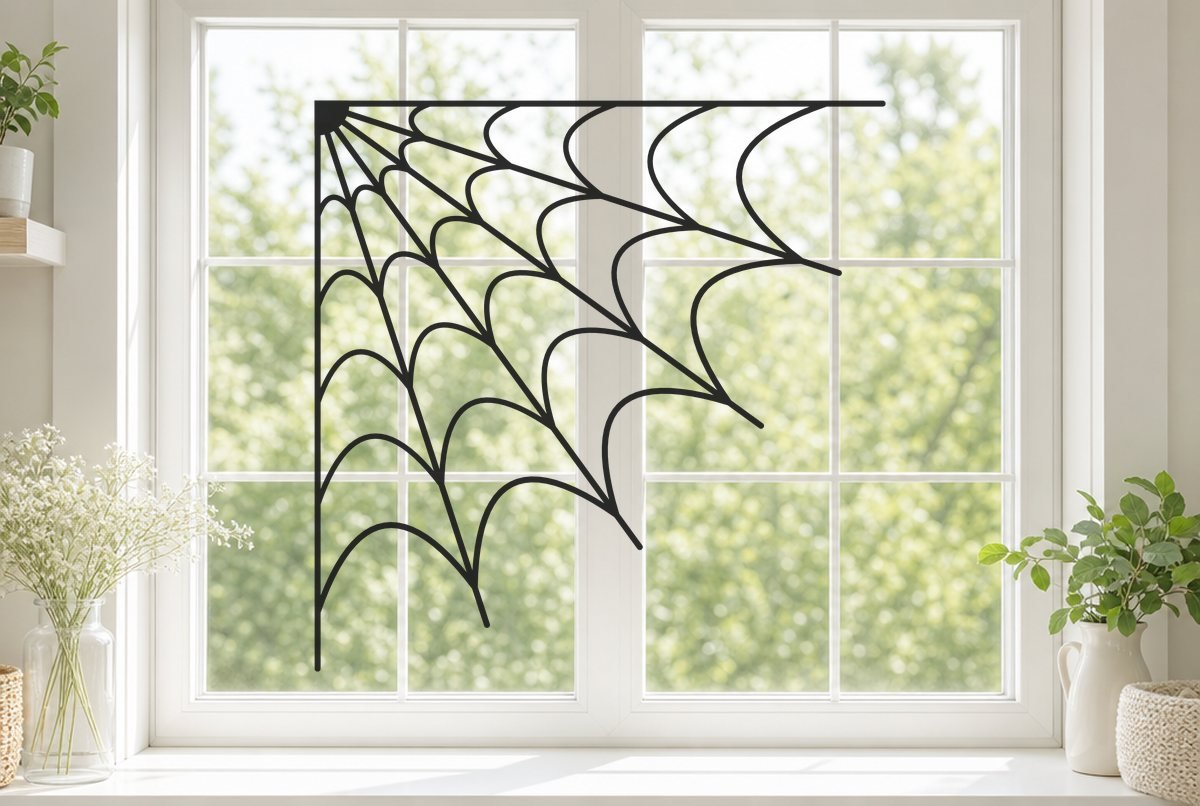
A web tucked into the corner of a window frame looks like it grew there. It’s one of the few Halloween decorations that works in daylight, from the street, without any lights. This spider web SVG is built for exactly that spot: quarter webs that sit into a square corner, one with a spider dropping from a thread, and a set of loose spiders to scatter around.
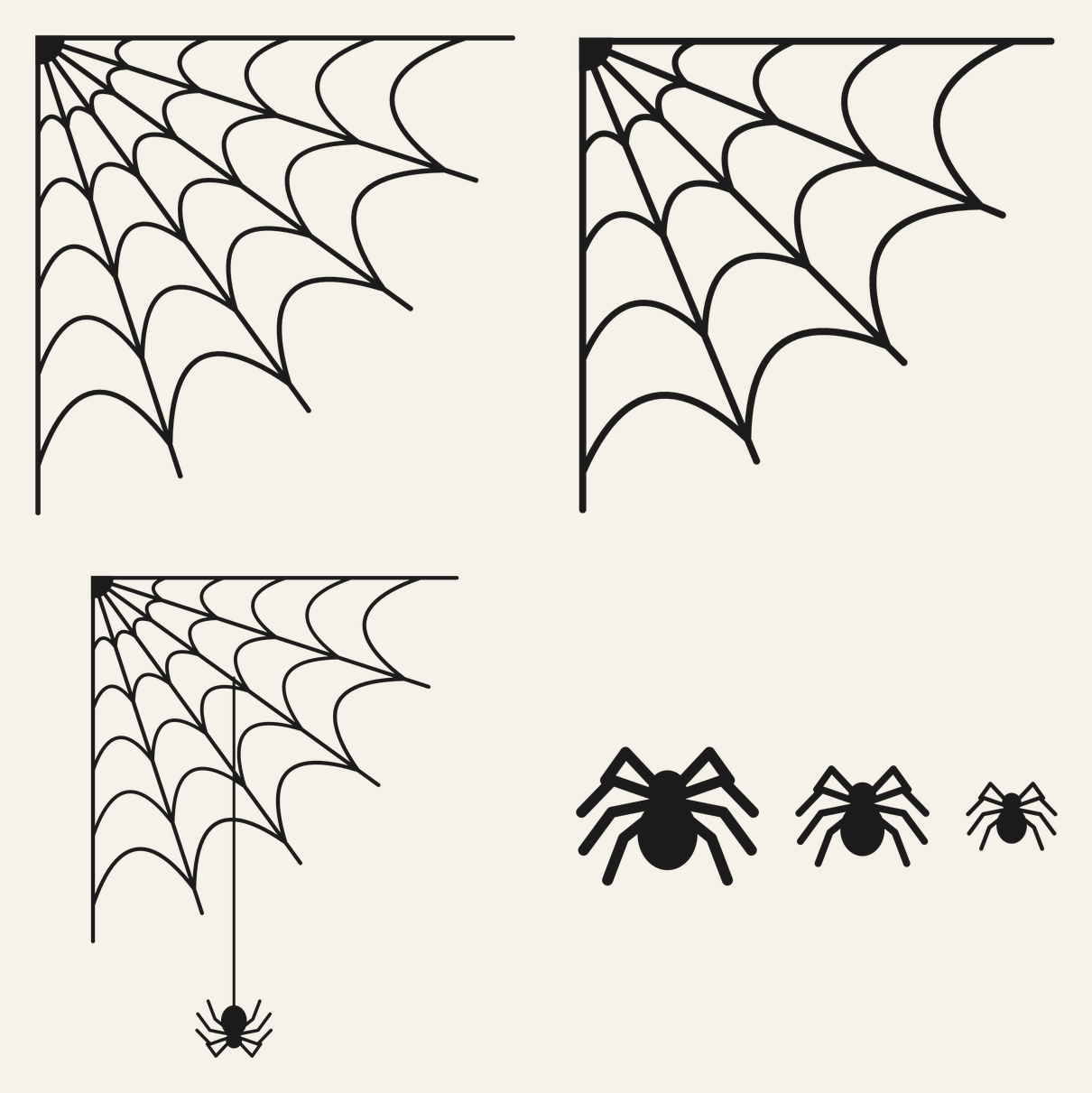
All four files are cut-checked for adhesive vinyl. The corner webs come in 8.12 x 8.12 in and 5.12 x 5.12 in. The hanging-spider web is 8.5 x 11.12 in, and the spider set has three spiders at 3, 2.2 and 1.5 in wide on one 8 x 2.5 in file. Use removable vinyl or window cling, since these come down in November.
| File | Size | Material | Layers | Check |
|---|---|---|---|---|
| Corner spider web, 8 in | 8.12 × 8.12 in | Vinyl | 1 layer | ✓ Cut-checked |
| Corner spider web, 5 in | 5.12 × 5.12 in | Vinyl | 1 layer | ✓ Cut-checked |
| Corner web with hanging spider, 11 in tall | 8.5 × 11.12 in | Vinyl | 1 layer | ✓ Cut-checked |
| Spider decals, 3 sizes (3, 2.2, 1.5 in) | 8 × 2.5 in | Vinyl | 1 layer | ✓ Cut-checked |
What’s in the web files
Each web is drawn for the top-left corner of a window. The two outer strands run straight along the frame edges, the others fan out from a small solid hub in the corner, and the rings between them sag into the loose curves a real web has. The big web has six spokes and five rings. The 5 in web drops to five spokes and four rings, so its openings don’t get too small to weed.
The whole web is one piece. Every strand is welded where it crosses the next, so the 8 in web cuts as a single shape with 25 openings inside it, and the 5 in web has 16. The strands run a little under a tenth of an inch wide. That’s thin enough to look like a web and still wide enough to pass our adhesive vinyl check at the listed sizes.
On the hanging version, the thread is welded into the web and the spider is welded onto the end of the thread, so web, thread and spider cut as one piece. Nothing to line up: it all comes off the liner together.
The spiders are chunky: an oval body, a smaller head and eight bent legs. The legs get a bit thicker in proportion as the spiders shrink, so the 1.5 in one still has legs you can weed.
What you need
- Removable adhesive vinyl, or window cling
- Standard grip mat, 12×12
- Weeding hook
- Transfer tape (for vinyl)
- Scraper or an old gift card
- Glass cleaner and a lint-free cloth
Cutting and hanging the webs
- Upload the files. In Design Space, click Upload on the left of the Canvas, then Upload Image and Browse. The upload guide has the full walkthrough. Silhouette users can use the DXF files in the ZIP.
- Set up your corners. The files open as top-left corners. For a top-right corner, duplicate the web and flip it with Mirror > Horizontal in the Edit bar. Flip it vertically as well for the bottom corners. Leave the sizes alone.
- Choose your material. Click Make and pick the setting for your removable vinyl or window cling. Vinyl doesn’t need mirroring. For window cling applied to the inside of the glass, flipping only changes which corner the web fits.
- Weed from the corner out. Start at the hub, where the openings are smallest, and lift each one with the hook. Then peel the outer background away low and slow. Pulling it up fast is how thin strands stretch. The weeding guide covers the angle.
- Tape and burnish. Lay transfer tape over the whole web and rub it down firmly, strand by strand. Thin lines need more burnishing than solid shapes before they’ll let go of the liner.
- Apply into the corner. Clean and dry the glass. Peel the liner, line the two straight edges up with the frame, press the corner hub down first and smooth outward along the spokes. Peel the tape back flat against the glass.
On painted window frames and walls, stick with removable vinyl. Permanent adhesive is made to stay and can lift paint when it comes off. Permanent vs removable vinyl explains where each belongs.
Which web for which window
| Spot | File | Size |
|---|---|---|
| Front window or glass door, seen from outside | Corner web, 8 in, or hanging spider | 8.12 in square, or 8.5 x 11.12 in |
| Small panes, sidelights, cabinet glass | Corner web, 5 in | 5.12 in square |
| Mirror corners, picture frames | Corner web, 5 in | 5.12 in square |
| Walls, trim, lampshades, jars | Spider set | 3, 2.2 and 1.5 in spiders |
| Big picture window | Corner web, 8 in, scaled up | 8.12 in or larger |
Enlarging is always fine. Shrinking a web below its listed size narrows every strand at once, and they’ll start tearing as you weed. If a corner is too small for the 5 in web, a single spider looks better than a cramped web.
Ideas beyond the window
Put the 8 in web in the top corner of a mirror and a 2.2 in spider low on the glass, as if it’s on its way up. White vinyl on a dark front door reads well from the sidewalk. The spider set also makes good bits for a party: one on each treat jar, or a trail of them climbing a wall toward a doorway.
For a whole haunted window, add the flock of bats from our bat SVG for window clings. If you haven’t made clings before, how to make window clings with a Cricut covers the material.
If a strand breaks while you weed, don’t toss the web. Finish weeding, put the transfer tape on, and nudge the broken ends back together on the tape before you apply it. On glass, a small break near the edge is hard to spot from outside.
Questions
How do I make a spider web for the other corner of the window?
Duplicate the web in Design Space and flip it horizontally (Mirror in the Edit bar) for the top-right corner. Flip vertically too for the bottom corners. Flipping doesn’t change the size, so the cut check still applies.
Should I use removable or permanent vinyl for window spider webs?
Removable, or window cling. Both come off after Halloween, and removable vinyl won’t lift paint from a window frame the way permanent can.
How small can I cut the corner spider web?
Keep the smaller web at 5.12 in or larger. That’s the size it was checked at; below it, the strands get too thin to weed without tearing.
Is the hanging spider attached to the web?
Yes. The thread is welded into the web and the spider hangs from the end of it, so the whole design is one piece of vinyl.